How PageProof helps nonprofits and charities approve with confidence
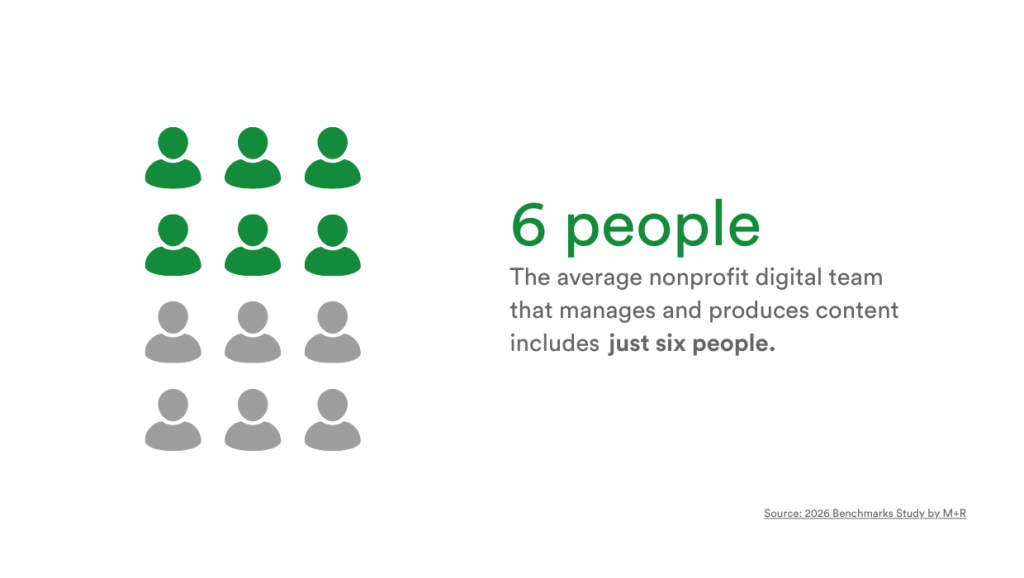
Nonprofits punch well above their weight when it comes to creative output relative to team size. According to the 2026 Benchmarks Study by M+R, a fundraising and advocacy agency that surveys nonprofits on their marketing performance each year, the average nonprofit digital team, the staff who manage, produce, or report on marketing, fundraising, and advocacy content, includes just six people.
Nonprofit marketing teams are doing more with less.
And even as revenue climbed and nonprofits produced more content across more channels in 2025, most digital teams either stayed the same size or shrank. This means all of the content regularly produced by nonprofits: donor gift books, event signage, brochures, social graphics, newsletters, campaign materials, health information, and TV commercials, is often reviewed by a small team wearing several hats, sometimes with legal, medical, or compliance sign-off required before anything goes live.
Despite producing more content with smaller teams, many nonprofits manage their review and approval process manually — with feedback scrawled on printed proofs and scattered across channels, which creates bottlenecks, version confusion, and missed compliance checks.
Why approval processes break down in charities and nonprofits
The nonprofit sector faces a distinct set of pressures, from stretched teams to accuracy demands that carry real consequences if things slip through.
Occasional and non-specialist reviewers
Unlike commercial creative teams, many nonprofit reviewers aren’t full-time creatives or regular proofers. Staff from other departments are often pulled in only occasionally to check a piece of work, sometimes as volunteers rather than as part of their core role.
Feedback is distributed across disconnected channels
Revision requests often arrive through whatever channel is fastest for the reviewer: email, instant messaging, or even handwritten notes. With no consolidated record of what was said or actioned, critical context gets lost between the person giving feedback and the person implementing it, leading to delays, confusion, and errors creeping into the final work.
Complex, multi-team review chains without a clear structure
Whether it’s several departments, each with their own standards, or a small team juggling multiple roles, content often needs sign-off from more than one place before it can go out. Without structured workflows to control the order and timing of notifications, review chains like this are prone to bottlenecks, with content stalling while waiting on the slowest or least engaged reviewer.
No single source of truth as versions multiply
When feedback and files are scattered, it becomes difficult to know which version is actually current. A single proof copy assumed to be final can go to print or distribution before a wider review catches the inconsistencies or errors that a lone reviewer missed.
What manual review and approval process look like across the nonprofit and charities sector
Three PageProof customers show how these pressures can play out day to day, each shaped by a different mission.

Southeastern Guide Dogs (now Dogs Inc.), a Florida based nonprofit organization, trains guide dogs, service dogs, and companion dogs at no cost to the people who receive them, and produces a constant stream of brochures, donor materials, invitations, and event collateral to support that work. Their proofing process was often over-the-shoulder or passed around as multiple printed copies in different hands.
That approach eventually let a real mistake through. An event t-shirt was printed with ‘to’ instead of ‘too’ — a small error, but a clear sign their process was too rushed to catch it.
“With so much production, our proofing was often over-the-shoulder or consisted of multiple printed copies in different hands.
Leslie Rowe, Marketing Writer, Southeastern Guide Dogs.
YWCA, the oldest and largest direct service organization supporting women and families in the greater Seattle area, originally routed physical proofs around the office by hand.
Each proof had a proofing sheet attached to give the process some structure, but the predictable issues of a physical route still crept in: proofs regularly got lost or stuck on someone’s desk, and it was often unclear who had left which comments, or whether they’d been actioned at all.
The team eventually moved from paper to an early digital proofing tool, hoping it would solve these problems, but the tool didn’t match their expectations, and staff struggled to adopt it consistently. On top of that, much of YWCA’s work is cross-team, with more complex projects involving a stakeholder hierarchy rather than a flat group of reviewers, a structure neither the paper process nor the first digital tool was built to support.
“Our original review process was physically routing paper proofs around the office that folks marked up.
Dan Weisbeck, Marketing & Operations Director, YWCA.
British Heart Foundation operates at a different scale entirely. Its content, ranging from national campaigns and TV commercials to fundraising packs and clinical information, must pass through twelve review teams.
In its busiest month alone, the brand team reviews up to 250 proofs, with more than 1,500 reviewed across this year, and even minor delays or miscommunications at that volume compound quickly.
Different missions, different scale, but the same underlying issue — none of these organizations had a system built to match the volume, complexity, or stakes of the work they were producing.
“We’re a large organisation, and our work needs to go through many different review teams.
Bertie Teague, Senior Brand Guardian Executive, British Heart Foundation.
What each organization was looking for in a solution
Despite different missions and different scales, these three organizations were looking for many of the same underlying capabilities.
For Southeastern Guide Dogs, the priority was getting a wider range of eyes on their work without adding complexity. After the printed-shirt mistake, it was clear that the team needed a way to bring in more reviewers, including staff from departments with no design background, without requiring specialist proofing knowledge or a steep learning curve.
YWCA needed a platform that could support their more complex, cross-team projects, which often involved a stakeholder hierarchy rather than a flat group of reviewers. Their previous digital tool had been difficult to use, so simplicity mattered as much as functionality. Whatever replaced it needed to be intuitive enough that staff wouldn’t quietly revert to email and paper out of frustration. The team also wanted the ability to control when specific reviewers were notified, rather than looping everyone in at once, regardless of relevance.
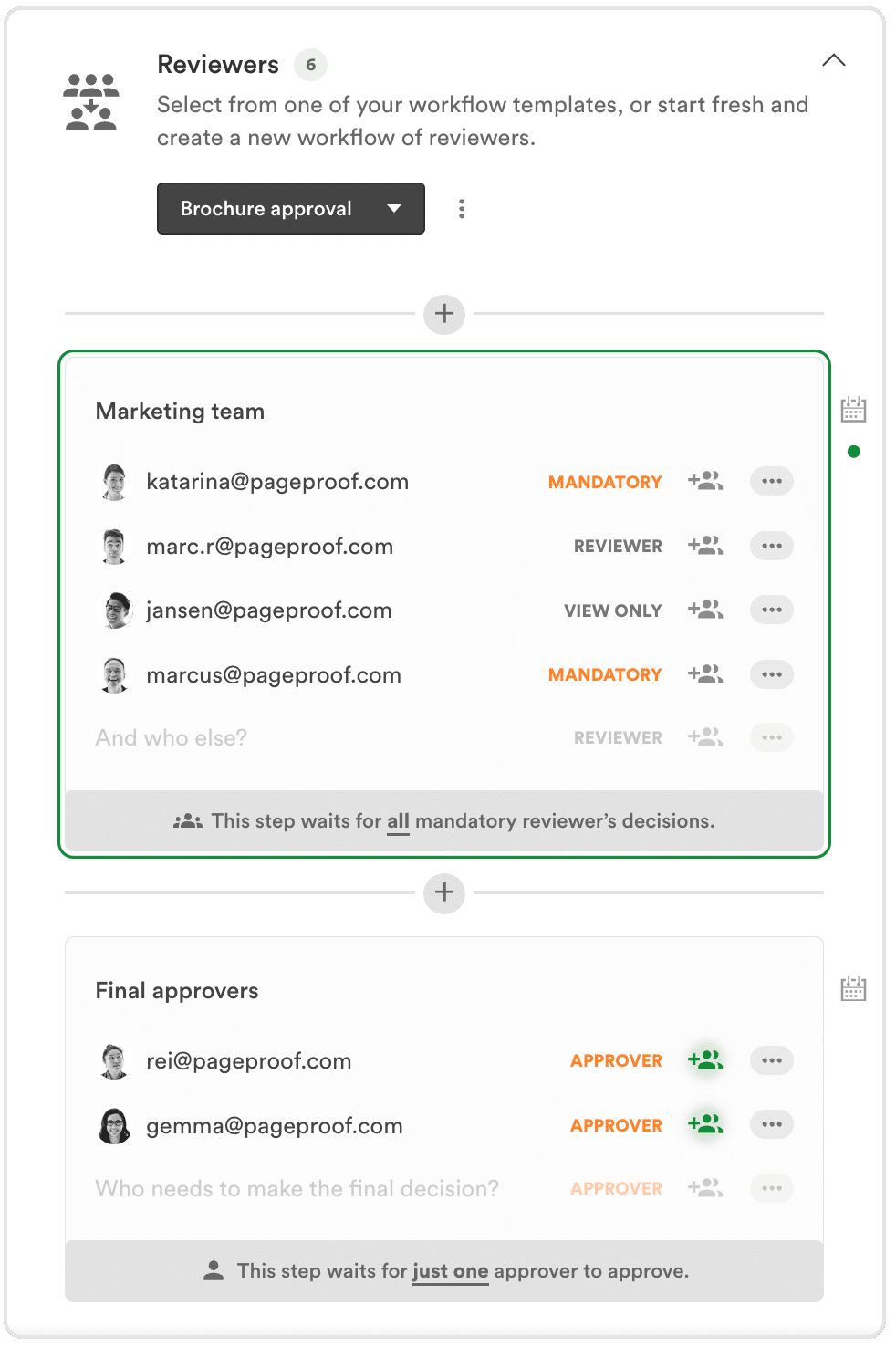
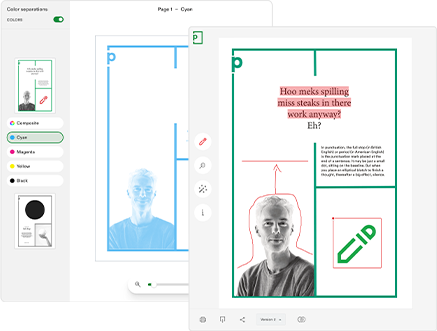
Inside PageProof, you can set an automated approval workflow for a proof that defines who reviews it and in what order.
British Heart Foundation’s needs were shaped by scale and governance. With content passing through multiple review teams and the Brand team alone handling up to 250 proofs in a busy month, they needed a system that could group related assets for review, support a repeatable multi-version approval process, and let reviewers approve a proof with only minor changes noted rather than restarting the cycle for small tweaks.
Visibility into review volume and bottlenecks also mattered, so the team could adjust staffing or turnaround expectations during peak periods rather than being caught off guard.
Across all three organizations, the common thread was accountability without added overhead: a documented record of who reviewed what, and when, that didn’t require a dedicated admin resource to maintain.
How PageProof helps address these challenges
Southeastern Guide Dogs: bringing in more reviewers without adding complexity
Having already seen how a rushed process let a mistake through, Southeastern Guide Dogs needed a way to widen their review process beyond passing printed copies around by hand, without requiring reviewers to have design experience or specialist proofing knowledge.
With PageProof, they could bring 15 staff members from across the organization into one shared proof as occasional reviewers on their donor gift book, a coffee table book of commencement speeches.
Because the platform was easy to adopt, these first-time reviewers were able to contribute meaningfully rather than just rubber-stamping the work. That wider review caught small inconsistencies and design feedback, including issues with the readability of photo captions, that the original single-copy proof had missed entirely.
The team achieved 100% adoption across the group, with everyone able to review the book without extra training.
100% of the Southeastern Guide Dogs team adopted PageProof.
YWCA: replacing a fragile paper process with structured, cross-team workflows
YWCA’s proofs were previously routed by hand around the office, getting lost or stuck on desks, with no clear record of who had left which comments. The organization needed a platform simple enough for staff to actually use, yet powerful enough to support their complex projects, which often involve a stakeholder hierarchy rather than a flat group of reviewers.
PageProof’s configurable workflows solved both problems: they let YWCA control the order and timing of notifications so specific reviewers were only looped in when it’s their turn, and they gave reviewers a way to discuss feedback directly within the proof itself, rather than losing context across scattered channels.
The result was a fully standardized, centralized review process that matched the complexity of YWCA’s cross-team projects, without the adoption struggles of their previous tool.
YWCA brought its entire review process into one place with PageProof.
British Heart Foundation: managing scale, versioning, and compliance without added admin
With content passing through twelve review teams and the brand team alone handling up to 250 proofs in its busiest months, more than 1,500 across the year, British Heart Foundation needed a system built for volume and governance.
Three PageProof features addressed this directly. Collections let proof owners group related assets from the same campaign together, so reviewers could compare and give consistent feedback across a whole set of materials rather than reviewing each piece in isolation.
Smart compare carried feedback through BHF’s three-version review process without guesswork, ensuring nothing got lost as proofs moved from draft to final approval. And the ‘approved with changes’ proof status let reviewers sign off proofs needing only minor wording or spelling adjustments, without restarting the entire review cycle for small tweaks.
On top of this, real-time reporting gave the team visibility into peak review periods, letting them adjust service level agreements or add review support during busy times rather than being caught off guard. Together, these features let the British Heart Foundation team maintain consistency and brand recognition across teams, at high volume, without adding administrative overhead.
“The introduction of PageProof has made BHF’s external communications more consistent, boosting brand recognition and trust.”
Bertie Teague, Senior Brand Guardian Executive, British Heart Foundation
Helping nonprofits bring structure to their review process
Across the sector, the same issues repeat themselves: reviewers who aren’t full-time proofers and don’t know the process, feedback split across email and other channels, multi-team sign-off chains with no clear order, and files that multiply until nobody’s sure which one is final.
PageProof addresses each of these directly. Reviewers with no design or proofing background can give feedback easily. Workflows help control which reviewer gets notified and when, so multi-team chains move in order instead of stalling on the stakeholder who hasn’t responded. And because everyone works from one shared proof, there’s never any doubt about which version is current.
Every comment and decision stays attached to the proof itself, so feedback given by email or in person doesn’t get lost or misread later. The result is a review and approval process that gives nonprofits the confidence that every piece of content is accurate, on-brand, and signed off by the right people, without requiring more staff, more budget, or more time than teams already have to give.
Like what you see?
Learn how leading teams speed up approvals, simplify creative reviews, and collaborate securely at scale.