Digital signing explained: how it works, benefits, and use cases
As marketing teams handle more campaigns, proofs, and approvals than ever before, manual or informal approval methods can quickly become a bottleneck. Approvals get delayed, compliance becomes harder to maintain, and records may be incomplete, tampered with, or legally vulnerable.
With so many assets moving through review, marketing teams need a way to capture approvals accurately and ensure every sign-off is transparent, eliminating risk.
This is where digital signing makes a real difference. It provides a secure, verifiable, and efficient way to approve proofs by ensuring that each signature is tied to a verified identity and that the integrity of the document is fully preserved. Teams gain confidence that every approval is trustworthy, legally sound, and auditable, reducing risks and keeping workflows moving smoothly.
With digital signing in place, organizations can streamline approvals, maintain compliance, and help teams focus on what really matters: creating, collaborating, and delivering work with speed and accuracy.
What is digital signing?
Digital signing is the process of applying a cryptographic signature to a digital document or proof using a trusted digital certificate. This certificate is unique to the signer and creates a secure, verifiable link between the signer and the document.
When a document is digitally signed, a mathematical fingerprint (hash) of its content is created and sealed to the signer’s certificate. If the document is altered in any way after signing, the fingerprint no longer matches, and the signature immediately shows as invalid.
Digital signing provides a trusted method to manage approvals, regulated workflows, audits, and legal documentation: it proves identity, safeguards integrity, and instantly exposes tampering.
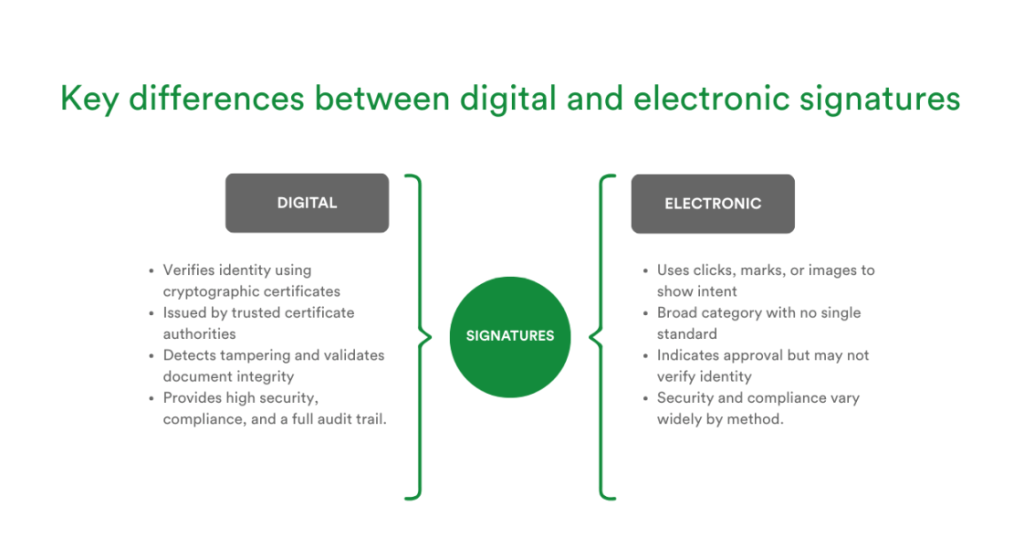
An overview of the key differences between digital and electronic signatures.
How digital signing works
Digital signing relies on a few core cryptographic concepts. While it can sound complex, you don’t need deep technical knowledge to understand how it works.
The process works as follows:
Verification and audit: Anyone with access to the signer’s public key can validate the signature, and every signed document is logged for traceable audit purposes.
Public and private key pairs: Each signer has a private key, kept secure, and a public key, shared to allow verification. When the signer approves a document, the private key generates the digital signature, uniquely tying their identity to the document.
Document hashing: A unique mathematical fingerprint (hash) of the document’s contents is created and linked to the signature. Any change to the document after signing alters the hash, immediately invalidating the signature.
Certificate Authorities (CAs) provide trust: Signers receive digital certificates from recognized CAs, which verify their identity and bind their public key to them. This creates a trusted, auditable chain of verification.
Tamper-evident seals: The signature and hash form a sealed layer on the document. If someone alters the content, the seal breaks, signaling tampering instantly.
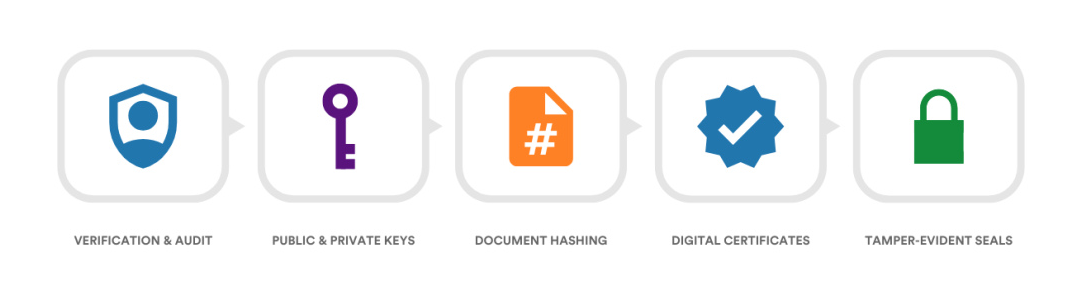
How digital signing works – from verification to tamper-evident sealing.
Why is digital signing used?
Approvers are responsible for confirming that content is correct, compliant, and ready to go. Without a secure, verifiable way to capture their approval, organizations face delayed projects, legal exposure, and incomplete or tampered records.
With 56% of marketing compliance teams spending at least six hours each week on manual review, the risk of human error and missed approvals increases significantly. A single overlooked approval on a campaign landing page, product brochure, or social media promotion can expose a brand to compliance violations or force last-minute rework.
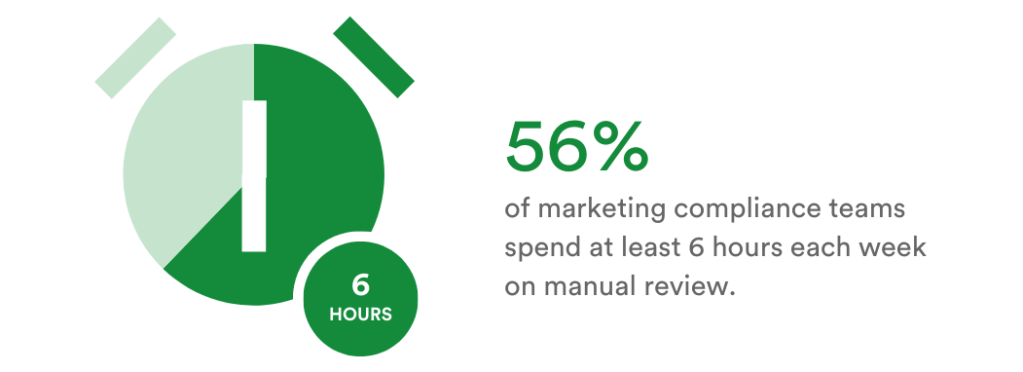
Manual review continues to consume a significant share of marketing compliance teams’ time.
Digital signing addresses these risks by linking each approval to a verified identity, making every decision traceable, auditable, and legally valid.
The main benefits for organizations and approvers are:
Authenticity
Digital signing verifies the identity of the signer, ensuring approvals genuinely come from the correct person. Because each signature is linked to a verified individual, organizations can trust the approval’s origin.
Security
Each approval is cryptographically verified, protecting content against tampering and unauthorized changes.
Legal validity
Digital signatures are recognised under laws such as eIDAS, the ESIGN act, and UETA, providing legally binding proof that the right person approved the right content at the right time.
Efficiency & workflow improvements
Approvers can sign off quickly without printing, scanning, or emailing, keeping projects moving while ensuring accountability.
Compliance & traceability
Every signature is recorded with time stamps and audit logs, giving approvers and organizations confidence that approvals meet internal governance and regulatory requirements.
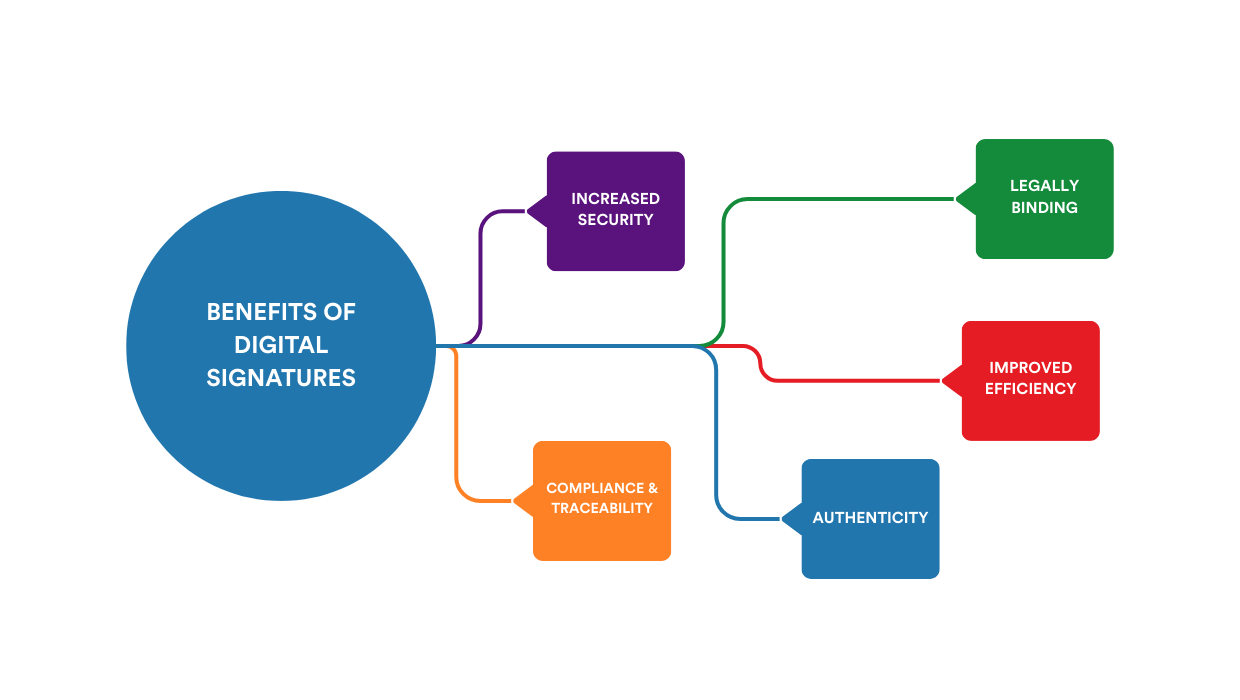
What digital signatures deliver: security, compliance, authenticity, efficiency, and legally binding approvals.
Types of digital signatures
Digital signatures vary in terms of security, identity verification, and legal recognition. The main types of digital signatures are:
Standard digital signatures
Standard digital signatures are typically used for internal approvals, consent forms, or routine documents where strong legal verification is not required. They provide a simple way to confirm the signer’s intent but may not include advanced identity verification or tamper-evident features.
Examples of a standard digital signature use might be signing routine purchase orders, standard vendor agreements, or internal forms that require acknowledgement.
Advanced digital signatures
Advanced signatures are uniquely linked to the signer through a verified digital certificate. They are tamper-evident, meaning any change made after signing immediately invalidates the approval. This gives organizations confidence that the content, not just the signature, can be trusted.
This is the type of digital signature PageProof provides because it aligns with what marketing teams need. The work these teams produce and approve is frequently public-facing, often in regulated industries, and typically moves through multiple rounds of review.
Packaging artwork, regulated marketing materials, ads, and landing pages that require compliance checks, multi-stage campaign assets, and brand materials all depend on a verifiable chain of approval and assurance that nothing has been altered after sign off.
For these kinds of projects, teams need certainty that the right person approved the correct version at the exact moment of sign off, and that the approval will remain valid and tamper evident throughout the asset’s lifecycle.
Qualified digital signatures (QDS)
Qualified digital signatures provide the highest level of trust. They are issued by accredited providers under strict regulations and are often required for highly sensitive or legally binding documents.
QDS verifies the signer’s identity and makes the document legally binding under the strictest standards. Examples of qualified digital signature use include signing government contracts, legal agreements in regulated industries, and pharmaceutical regulatory submissions.
Industries where digital signing is used
Government
Digital signing accelerates approvals for tax filings, permits, licensing applications, and official communications while keeping citizen records secure and fully auditable. It also speeds up review of government campaigns, public service announcements, and internal policy documents, reducing delays and administrative overhead across departments.
Pharmaceuticals
In pharmaceuticals, digital signing secures approvals for regulatory submissions, batch documentation, SOPs, and promotional materials. Creative assets such as patient leaflets, brochures, and packaging proofs can be approved with full traceability.
Healthcare
Digital signing helps healthcare teams approve and manage patient-related documents securely, including consent forms, medical records, insurance claims, and prescriptions. Marketing or educational materials for healthcare campaigns also need to pass through a compliant proofing process.
Finance & banking
Financial organizations accelerate approvals for loan agreements, account openings, investment documents, and vendor onboarding using digital signing. Internal reports, presentations, client-facing materials, or marketing campaigns can be routed through proofs, with verified, traceable approvals.
Packaging & manufacturing
Digital signing tracks approvals for artwork, packaging, supplier certifications, quality checks, and internal technical or creative reviews. Proofing workflows allow design and packaging materials to be signed off efficiently while preserving audit trails.
Legal and professional services
Digital signing supports approvals for contracts, NDAs, retainers, and other critical legal documents. Marketing campaigns, client proposals, and other professional materials can be routed through proofs for secure, verifiable sign-offs.
Education
Educational institutions use digital signing for enrollment forms, transcripts, staff employment contracts, and approvals for academic materials, creative content, or event marketing collateral.
Marketing, creative, and agency workflows
Digital signing accelerates approvals for creative campaigns, multi-stage proofing processes, and version tracking. Marketing materials, ad creatives, product packaging proofs, and social media content can be signed off quickly, reducing errors while maintaining compliance.
The importance of digital signing for creative and marketing teams
Creative, marketing, and legal teams often manage multi-stage approval workflows for assets such as brochures, presentations, social campaigns, packaging, and regulatory or legal documents.
With multiple reviewers involved, organizations need to maintain a clear, verifiable record of every approval while keeping the workflow efficient.
Digital signing links each approval directly to the individual, providing a verified record of who approved what and when. This is vital for accountability and governance: the approver’s name next to a proof confirms responsibility, protects the organization in case of disputes, and ensures that both creative and legal requirements are met.
Approvers can confidently sign off on work knowing that each decision is traceable, legally verifiable, and tamper-evident.
For industries with strict compliance needs, such as healthcare, finance, and pharmaceuticals, this level of verification ensures that creative, marketing, and legal assets meet governance standards without slowing down the review and approval process.
Digital signing with PageProof
Digital signing is essential for accountability, traceable approvals, and legal validity. Organizations need a solution that embeds this rigor directly into the proofing workflow – and this is exactly what our digital signing capabilities offer.
At PageProof, we combine the stength of cryptographic digital signing with an intuitive proofing workflow, allowing teams to approve content quickly while maintaining enterprise-grade security.
Enterprise customers wanted a way to integrate the simplicity of PageProof’s review and approval process with the robustness of formal digital signing – without adding friction.
Approvers can sign off on proofs as they always have while the platform maintains full compliance behind the scenes.

Approvers see a shield icon on the Approve button, signalling that their approval will generate a digital signature.
The result is the same effortless experience reviewers love, paired with the confidence IT and compliance teams require, particularly in highly regulated industries.
How digital signing works within PageProof
When digital signing is turned on in PageProof, approvers authenticate themselves before approving a proof.
Each approval then generates a verified digital signature – a cryptographic thumbprint that uniquely links the approver’s identity to that specific proof version and the exact moment of approval.
Admins can configure an authentication expiry window, letting approvers sign multiple proofs securely in the selected timeframe without having to reauthenticate each time.
How PageProof future-proofs approvals
PageProof’s digital signing uses the FIPS 204 ML-DSA-87 algorithm to deliver enterprise-grade, FIPS-compliant, quantum-ready security.
This advanced cryptography keeps signatures resilient against emerging threats and protects proof integrity well into the future.
Each signature is permanently stored in the proof’s secure audit trail – an immutable record of who approved and when – making it ideal for audits and governance reviews.
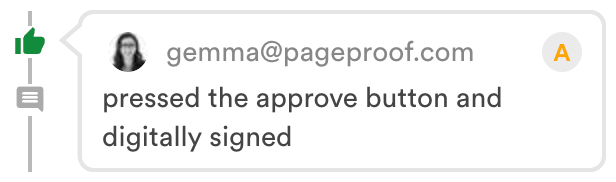
Every digital signature is captured in PageProof’s audit trail, showing exactly who approved and when.
Every digital signature is captured in PageProof’s audit trail, showing exactly who approved and when.
Digital signing adds a secure, cryptographic layer to the review and approval workflow, combining simplicity for reviewers with enterprise-grade compliance for organizations.
At its core, each approval becomes a verified digital signature, uniquely linking the approver’s identity to the specific proof and the exact moment of approval. This makes every proof traceable and legally verifiable, while keeping the review workflow intuitive for users.
The benefits for enterprise teams
PageProof’s digital signing delivers tangible advantages, giving teams confidence that every approval is secure, compliant, and easy to manage.
In practice, this translates to:
- Verified, tamper-proof proof approvals that give teams confidence every decision is authentic and intact
- FIPS 204 compliance using the ML-DSA-87 algorithm for enterprise-grade, standards-aligned security
- Post-quantum-ready cryptography that protects proof integrity into the future
- Approvals automatically recorded in PageProof’s secure, immutable audit trail, ideal for audits and governance reviews
- A seamless approval experience that adds security without adding extra steps for reviewers.
Digital signing reinforces PageProof’s commitment to security, auditability, and innovation – built for organizations where every approval matters and every signature must stand the test of time.