How PageProof helps creative agencies cut proof versions and speed up approvals
Getting a client’s approval on creative work rarely involves just one person. In an agency setting, it can move through account managers, then to the client, sometimes to the client’s own team, and back again before an asset is signed off.
A fragmented or difficult-to-manage review and approval process can create real issues for an agency, slowing down how quickly they turn around work and undermining the accuracy of what they produce — both of which put their reputation at risk.
Many agencies still run review and approval through Word documents, printed proofs, and email threads. Manual review methods which are ok for reviewing single documents, but struggle to scale for the review of creative assets.
Three PageProof customers — DRPG, Nexus Brands Group, and Charm — faced these issues before finding PageProof.
At DRPG, a single proof could go through six or more versions before a client signed off.
At Charm, account managers weren’t just relaying feedback; they’d become, in their Head of Creative’s words, “deciphering experts,” spending as much time interpreting what a client meant as the designer spent making the change.
Nexus Brands Group’s version of the same problem looked different on the surface but came from the same root cause. Managing marketing materials for 15+ brands, the company’s Creative Manager fielded feedback arriving through email, through comments left in monday.com, sometimes as a printed proof marked up by hand and sent back. Nothing was wrong with any single method – the problem was that there were several of them running at once, with no shared record of which comment belonged to which version.
Across all three agencies, the work itself wasn’t the bottleneck; the systems in place for feedback to travel through were.
Where manual approval processes fall short in creative agencies
The experiences documented by DRPG, Charm, and Nexus Brands Group point to a handful of recurring problems agencies face:
Before designers can act, feedback needs clarity from account managers
When a client marks up a document or leaves comments across scattered channels, someone at the agency has to interpret that before a designer can act. At Charm, that job fell to account managers who had to have in-depth conversations with clients just to understand what a comment meant before passing it on.
Versions multiply faster than deadlines allow
Every round of feedback that isn’t captured cleanly tends to produce another full version rather than a targeted fix. At DRPG, six or more versions per proof was standard before a piece of work was approved.
Tools multiply along with the versions
Agencies work across whatever systems a client happens to use, on top of their own internal tools. For example, as Nexus Brands Group’s Creative Manager described: proofs were approved via email, via comments in monday.com, and sometimes printed out and marked up by hand, so three separate systems were running at once, with nothing tying them together.
Scale turns inefficiencies into a systemic problem
Managing feedback manually for one project is a nuisance, but manageable. Doing it across 15+ brands like Nexus Brands Group, or multiple clients and their suppliers, turns that nuisance into considerable lost hours.
Accountability has nowhere to live
Without a central location to show where every comment, decision, and version is logged, agencies lose the ability to show a client, or their own leadership, exactly what was approved, when, and by whom.
What agencies look for in a proofing solution
Despite facing the problem from different angles, — DRPG and Charm as agencies serving outside clients, Nexus Brands Group as an in-house team managing its own brands — all three were looking for similar features in a solution.
For DRPG, tracking and having visibility into changes made on a proof was a must-have. Under their old approval process, Word and Adobe comments left gaps, so the agency needed every comment, decision, and version captured, with a clear audit trail behind it.
They also wanted an Adobe InDesign integration for their design team, so change requests would show up inside the design itself rather than in a separate tool.
Charm needed automated workflows that moved a proof forward the moment key stakeholders had reviewed it, removing the need to manually chase clients and suppliers. They also wanted to eliminate the admin work involved with creating hi-res PDFs and emailing them out one by one.
Nexus Brands Group needed native connectivity between their existing tools: Adobe Creative Cloud and monday.com. Integrations with these existing tools meant that proofs, feedback and approvals could stay visible without requiring the team to leave the platforms they already used day-to-day.
How PageProof helped each agency address these challenges
DRPG
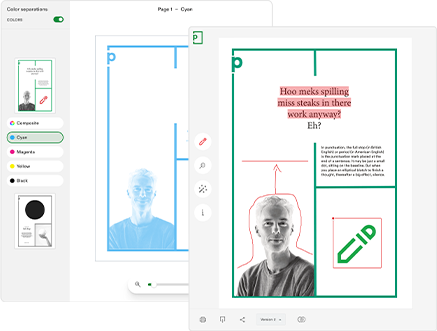
PageProof puts every comment, decision, and version history against a single proof rather than a document that gets exported and re-sent each time someone responds. When a reviewer leaves feedback, it pins directly to that spot on a proof and becomes a to-do item the designer can see and check off when the change is made, rather than a separate email or a tracked-changes edit on a Word file.
Because feedback lives on the proof itself instead of triggering a new file export, a new version is only created when the designer has actually made the changes requested, not every time a comment is added.
That’s what allowed DRPG to cut their proof versions needed to move a piece of work from draft to approval and it gave them a complete, auditable, record of who commented, decided, and approved at each stage.
The Adobe InDesign plugin extends these capabilities into the design tool itself: the same to-do list of requested changes that appear on the proof also shows up inside InDesign, so a designer can see and resolve feedback without switching out of the file they’re already working in.
“Traditionally, we’d used tracked changes in Word or Adobe, but PageProof is far superior in every way.”
Claire Blackford, Account Manager, DRPG.
Charm
On a PageProof proof, a client’s comment is pinned to the exact point on the asset it refers to rather than typed as a general note or handwritten on a printout. So, a designer sees precisely what’s being flagged, without an account manager first having to interpret what the client meant and translate it into an instruction.
PageProof’s workflows also route a proof to the next reviewer automatically once the current one has completed their review, and sends reminders to reviewers when action is needed, rather than requiring someone at Charm to manually check in or follow up by email.
Charm saved 25% of the time they used to spend on tasks like generating hi-res PDFs and emailing them to clients and now spends zero time collating feedback from separate sources.
“When you add those inefficient tasks together, the time savings for our agency are hugely significant.”
Anton Evans, Head of Creative, Charm.
Nexus Brands Group
With PageProof, Nexus Brands Group’s review and approval process is now completely connected. PageProof integrates natively with Adobe Creative Cloud and monday.com, so a proof created in one system stays linked and updated across the other, rather than requiring files to be exported, emailed, or manually re-uploaded between platforms. A board in monday.com updates automatically as a proof moves through review, so a project manager can see comments, decisions, and status from within the item view itself.
Once a proof is approved, the final file is uploaded back to the monday.com board automatically using FinalFile Delivery, closing the loop without anyone needing to track it down and attach it.
This integrated creative approval tech stack, sped up Nexus Brands Group’s creative workflow by 40%, work that previously moved through email, monday.com, and even printed proofs marked up by hand across their 15+ brands.
“When I found PageProof, as cheesy as it sounds, it was love at first sight. It had all the features I was looking for, and more, to manage our brand work”
Claire De Leon, Creative Manager, Nexus Brands Group.
Bringing structure to creative agency approvals
None of these fixes required any of the agencies to change how they work with clients, or ask clients to change how they give feedback. DRPG’s clients still send feedback the same way they always did. Charm’s account managers still sit between the agency and the client. Nexus Brands Group still manages the same 15+ brands across the same design and project management tools. What changed wasn’t the relationship or the workload, it was where feedback landed once it arrived, and what happened to it from there.
A proof that used to take six rounds to close out now takes four. A comment that used to need translating by an account manager now lands exactly where it’s meant to. A board in monday.com that used to need manual updates now reflects what’s actually happening in real time. None of these are dramatic changes to how an agency operates day-to-day but they quietly remove the pain points of lost time, feedback chaos, and multiplied versions. This quiet centralization is what adds up to a very different way of working — and results in a huge positive impact.