How PageProof helps education providers fix their approval bottlenecks
Education marketing teams don’t just create content; they have to route it through a maze of stakeholders for approval. Faculty needs to weigh in, leadership needs to sign off, and compliance teams need to check the fine print before anything goes live.
And there’s a lot on the line: accreditation materials, official guides, and brand consistency across departments all hinge on getting approvals right.
The problem is that many education providers are still trying to manage this complexity with PDFs, printouts, and email chains — methods that were never meant to support complex approval processes.
Without a structured process, approvals slow down and become unpredictable. Teams lose track of which version of an asset is current, feedback is scattered across channels, and there’s no clear record of who’s reviewed what or what’s still outstanding.
The result is projects that stall instead of moving forward or, worse, going live with errors or inconsistent branding.
Why approval processes break down in higher education marketing
The higher education sector is faced with a distinct set of pressures — from fragmented stakeholder groups to compliance obligations rarely seen elsewhere.
Too many stakeholders with unclear authority
Approval for a single asset often requires input from marketing, faculty, legal, and more. Because the final decision-making authority is unclear, projects can stall indefinitely while awaiting response from the slowest reviewer in the chain.
This plays out in practice when institutional priorities shift or aren’t clearly set, leaving no fixed standard for who gets the final say, a challenge 20% of marketing leaders cite as a top-three barrier to achieving their enrollment marketing goals, according to EAB, a major consulting firm for more than 2,800 educational institutions, in its 2026 Higher Ed Marketing Outlook report.
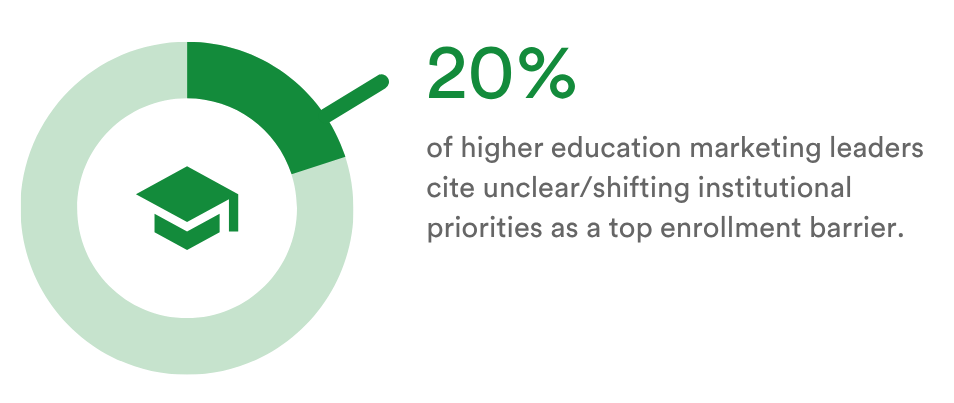
Shifting institutional priorities is a big barrier to higher education marketing success.
Inconsistent adherence to brand guidelines
Higher ed institutions often have multiple schools, departments, and student organizations that frequently produce creative independently of one another. Brand guidelines are typically documented, but in the absence of a centralized review process, adherence to those standards varies significantly across units.
Feedback distributed across disconnected channels
Revision requests are often communicated through a combination of email, instant messaging, and verbal discussion, with no consolidated record of what was said. Critical context is frequently lost in translation by the time feedback reaches the individual responsible for implementing it, resulting in avoidable rework and delay.
Fixed deadlines paired with variable approval timelines
Enrollment deadlines and academic calendar milestones are not subject to negotiation, yet the approval processes that precede them often lack a corresponding sense of urgency. This mismatch introduces considerable risk when materials require multi-party sign-off in close proximity to a hard deadline.
Additional layers of compliance review
Creative produced for educational institutions must frequently satisfy accessibility standards, privacy considerations related to student imagery, and accreditation-related accuracy requirements. Each of these obligations introduces an additional checkpoint.
Absence of a single source of truth for final versions
In the absence of a centralized system, teams often manage multiple iterations of an asset across shared drives and email threads, increasing the likelihood that outdated or unapproved materials are inadvertently published.
What happens when a manual approval process can’t keep up
Two customers were running into serious issues with their approval processes before finding PageProof.
Here’s what each was facing:
Cedarville University is a Christian liberal arts university in Ohio with more than 7,000 students, whose in-house marketing and communications division handles everything from design and video to web, PR, and social media.
Their team coordinated reviews through URLs, video links, and PDFs attached inside ClickUp, their project management system. The process was unclear and inconsistent: stakeholders were sometimes missed, feedback lacked clarity, and approvals weren’t reliably documented. Mistakes slipped through as a result, sometimes leading to costly reprints and reputational risk.
Manual feedback slowed everything down further. Time codes were typed by hand, annotated PDFs had to be re-saved and re-shared, and tracking edits across versions was difficult; video and web feedback in particular was slow, fragmented, and error-prone.
On top of that, coordinating more than 600 faculty and staff meant Cedarville needed a review process that could scale without adding complexity or slowing projects down.
Managing multiple file versions made it difficult to know which proof was current.
Chad Jackson, Associate VP for Creative Strategies, Cedarville University.
Competenz sets the training standards and writes the qualifications for 36 different industries across New Zealand’s vocational sector. That scale meant a wide range of people needed input on any piece of content.
Reviewing a 108-page trades guide, for example, meant pulling in sector specialists, product owners, schools, and Māori and Pasifika teams, all reviewing on paper, with red pens.
Each reviewer marked up their own copy, so feedback often overlapped or conflicted, and nobody could say for certain which version was current. It also wasn’t always clear who had reviewed a document, whether changes had been addressed, or what the latest version even was, so marketing managers spent valuable time chasing feedback and piecing together updates instead of driving campaigns forward.
Multiple reviewers rarely saw the same version at the same time, which made building consensus difficult and created constant bottlenecks. What should have taken a few weeks stretched into more than three months.
What both organizations were looking for in a proofing solution
Despite operating in different corners of education, Competenz and Cedarville were looking for the same capabilities in a solution: a single platform that could bring all reviewers together, eliminate duplication, and provide a clear, accountable review and approval process from first draft to final approval.
For Competenz, that meant centralizing feedback so the team could align faster and keep projects moving. Other key features they were looking for included:
- Automated reminders so stakeholders can be nudged at the right time to prevent delays from following up with people manually
- The ability to track every change in one place, with a clear audit trail showing who commented, when it was actioned, and what decisions were made by whom and when
- For designers, an integration with Adobe InDesign was essential, with the ability to see what changes had been requested to a proof inside the tool.
Designers love the InDesign integration — total control,
clear to-dos, no missed changes.
Katherine Hall, Marketing Manager, Competenz.
Cedarville’s needs were similar in nature. They needed to formalize their review process so every stakeholder reviewed what they needed to, in order and on time, to avoid feedback falling through the cracks.
The team wanted to keep ClickUp, their project management tool, at the center of their creative workflow. They also needed a more accurate way to review dynamic content, since live web pages and emails had previously been hard to comment on with the current tools they were using.
Finally, with more than 600 faculty and staff to coordinate, the platform had to scale effortlessly, without adding complexity to their processes.
“Implementing PageProof was excellent. The platform struck a great balance between being intuitive and user-friendly.”
Chad Jackson, Assistant VP for Creative Strategies, Cedarville University
How PageProof helps address these challenges
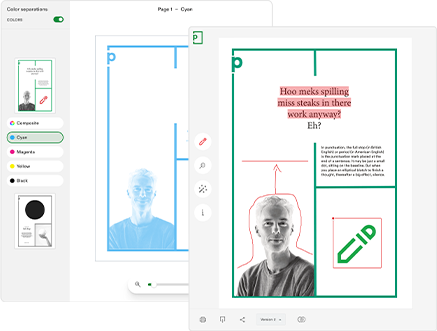
PageProof brings every reviewer into a single, shared proof, so feedback from different departments, specialist teams, or external stakeholders lives in one place instead of being split across separate copies and channels.
Reviewers are automatically reminded when action is needed, removing the need to chase approvals manually. Every comment, decision, and version change is logged automatically, creating a clear audit trail of who did what and when.
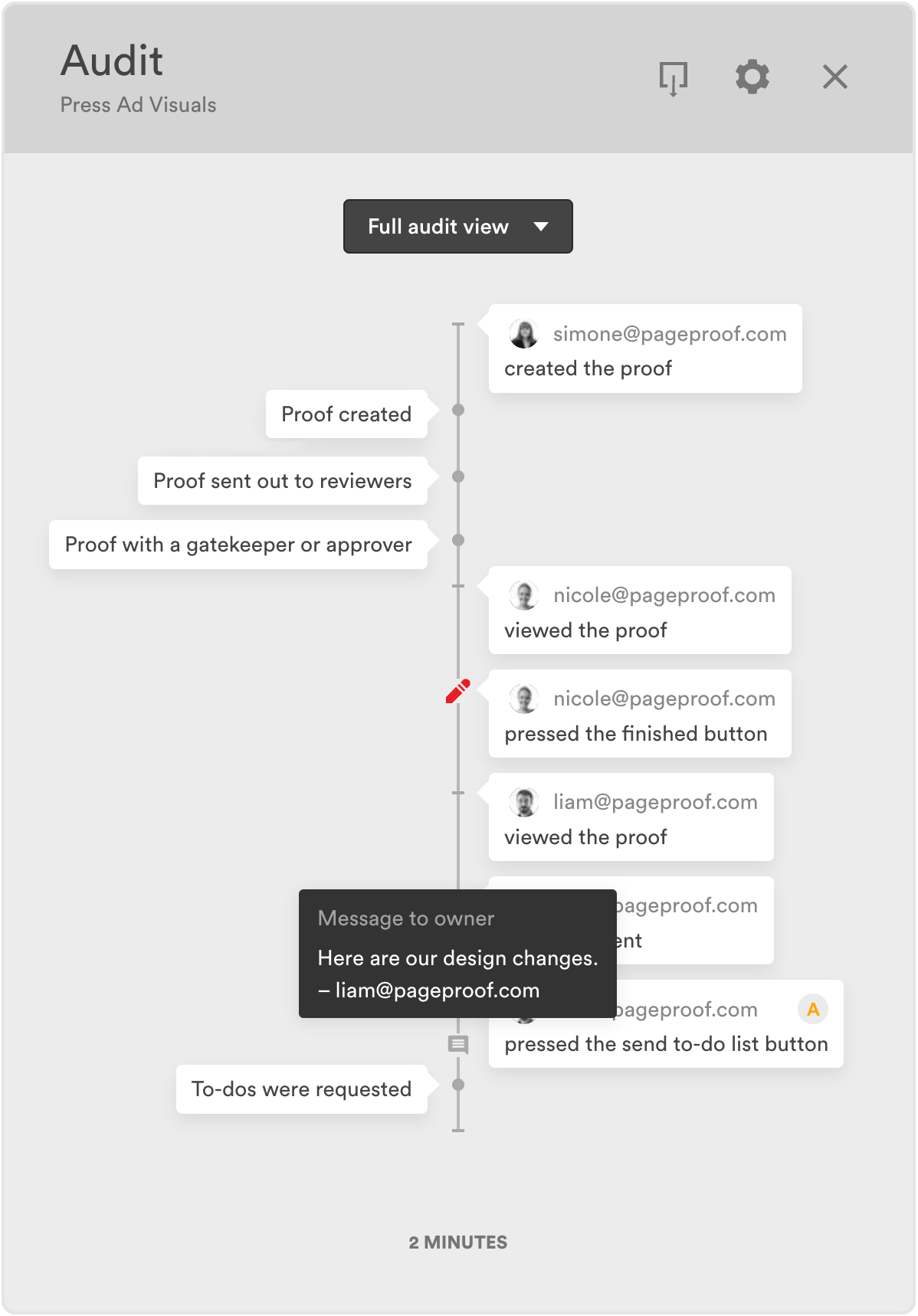
A proof audit within PageProof.
For designers, native integrations with tools like Adobe InDesign bring proofing feedback directly into the file they’re already working in. For teams managing projects elsewhere, PageProof connects natively with project management tools like ClickUp, so proofing status stays visible without switching systems.
And because PageProof supports live websites, emails, video, and every other format a team produces, dynamic and static content go through the same structured review process.
Configurable workflows and permissions mean this structure holds whether a team has a handful of reviewers or several hundred, without adding complexity as it scales.
The results
The impact was realized quickly for both teams, though it looked a little different for each.
Competenz saw an immediate improvement to their proofing process. Reviewers became more engaged and responsive, and feedback was far easier to consolidate. Designers in particular valued the control and visibility they gained, every change tracked, nothing slipped through, and the InDesign integration made to-dos effortless to manage.
PageProof helped Competenz shorten their approval times by 46%
The messy, paper-based process gave way to a smooth digital workflow. Automated reminders kept deadlines moving, and with all feedback living in one place, confusion and rework dropped significantly. What once took over three months was completed in weeks — a 46% faster turnaround that freed the marketing team to focus on new projects.
Beyond speed, the process itself became more enjoyable. Teams no longer dreaded reviews, and stakeholders could see progress clearly from start to finish.
At Cedarville, PageProof eliminated the recurring problem of delayed projects and missed deadlines caused by proofing confusion. Standardized approval workflows brought structure and accountability, ensuring every proof moved efficiently through the correct approvers, helping avoid the costly reprints and production errors that came from rushed or incomplete reviews.
The ClickUp integration kept proofs and tasks perfectly aligned, allowing teams to track progress without switching between tools. Beyond efficiency, the proofing experience itself changed: workflows became smoother, communication clearer, and stakeholders across campus could see the exact status of any project. Confidence in the quality and accuracy of university materials increased across every department.
For both institutions, PageProof didn’t just streamline approvals; it built confidence that their materials were accurate, consistent, and ready to deliver.
Bringing structure to higher education approvals
Higher education marketing teams face real pressure when getting creative approved: unclear decision making authority, inconsitent brand adherence, scattered feedback, fixed deadlines across complex projects, added compliance checkpoints, and no single source of truth. Every one of these problems traces back to the to the same missing piece — a shared, structured place for review and approval.
PageProof provides that. Every stakeholder reviews the same proof in the same place, with comments, descisions, version changes logged automatically, so authority and accountability are never in question.
Brand standards hold across schools and departments because every asset moves through the same configurable workflow. Automated reminders keep fixed deadlines on track without manual chasing. Compliance checkpoints, whether for accessibility, imagery or accreditation, sit inside the same review process rather than bolted on separately. And because there’s only ever one current proof, teams always know which version is current and ready for approval.
For education marketing teams, that means creative work moves through review with the same clarity and confidence Cedarville University and Competenz found: assets approved on time, on brand, and by the right people.
Like what you see?
Learn how leading teams speed up approvals, simplify creative reviews, and collaborate securely at scale.