What are Content Credentials? Understanding their importance
With the huge volume of content being produced and artificial intelligence (AI) getting better all the time, it’s getting harder to tell what’s authentic and what might have been altered or generated by AI. As a result, more and more creative teams are turning to AI not only for generating content but also to streamline workflows and boost business efficiency.
From deepfakes to AI-generated images, the line between real and artificial is becoming blurry. That’s where Content Credentials come in – they help verify the authenticity and origin of digital content, providing transparency and promoting trust in what we see online.
- What are Content Credentials?
- Why should you care about Content Credentials?
- How Content Credentials work
- How can Content Credentials be used?
- What platforms currently support Content Credentials?
- Transparency builds trust around content
- Getting started with Content Credentials
- Introducing PI Content Credentials check
- Why Content Credentials are worth your attention
What are Content Credentials?
You can think of Content Credentials as a digital ID for your content. They’re pieces of information embedded into your creative work that tell the story of how it was created.
These credentials reveal who created the content, when it was made, and whether AI tools were used. This kind of transparency can help build transparency around the use of generative AI and is an important step in building trust around the source of creative assets.

Content Credentials are part of a larger initiative, called the Content Authenticity Initiative (CAI), aimed at promoting accountability in digital media. By providing details about the content’s journey, these credentials give creators and consumers alike the information they need to understand where content comes from and how it’s been modified.
Why should you care about Content Credentials?
As the internet becomes increasingly inundated with fake news and edited images, recognizing the source and authenticity of what you see is essential – especially in business environments. This is particularly important given that more than 15 billion images have already been created using text-to-image AI tools since 2022, according to recent research from Everypixel. This number is expected to grow by a further 17% by 2030.
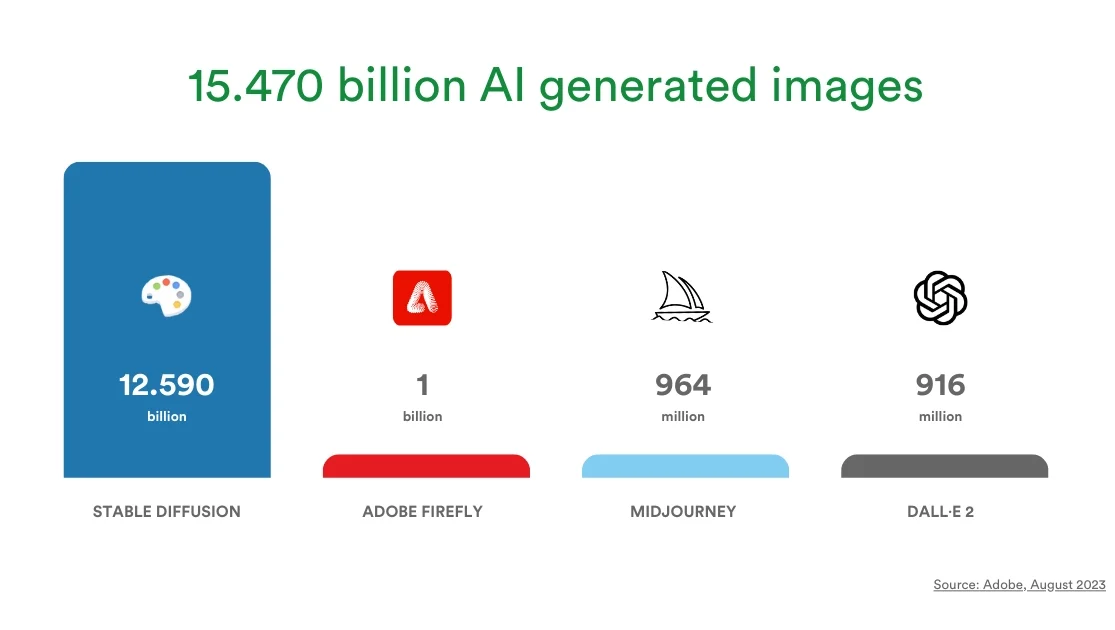
The amount of AI-generated images from each software since 2022.
Content Credentials offer peace of mind, whether you’re the creator or the viewer. For creators, these credentials ensure your work gets proper recognition. By attaching details like your name and creation date, you’re protecting your rights and making it easier to receive the recognition.
On the flip side, for consumers, Content Credentials provide clarity. If a piece of content has been heavily edited or generated by AI, the credentials let you know.
This kind of transparency helps you trust what you’re seeing online, making it easier to distinguish between genuine work and something artificially created.
How Content Credentials work
Whenever you export or save your work, Content Credentials can be attached as metadata that travels with the file.
This information stays with the content no matter where it is sent, giving future viewers a way to trace its origin. If AI tools were used – like Adobe Firefly or Dall.E – that information is included too.
What’s unique about Content Credentials is that they can build up over time. As a piece of content is edited or passed along, it collects new credentials, creating a history of the changes made.
This is especially useful for fields like photojournalism, where documenting every step of the editing process can be key to maintaining trust in the final product.
How can Content Credentials be used?
Content Credentials can be useful in many different areas. Some of the most common include:
- Creator attribution: If you’re a creator, you can attach your name and contact details to your work, ensuring you get credit wherever your content appears online.
- AI transparency: As more content is generated using AI tools, it’s important to be upfront about it. Content Credentials can tell viewers if and how AI was involved in the creation process, adding an extra layer of transparency.
- Photojournalism: For journalists and photographers, Content Credentials provide a clear trail of edits and attributions, giving viewers the ability to see how a piece of content has been handled since its creation.

Source: contentcredentials.org
What platforms currently support Content Credentials?
Content Credentials are being integrated across a wide variety of platforms, enhancing the authenticity of content creation, editing, publishing, and generative AI.
Here’s a look at some of the key players and how they’re using Content Credentials.
Content creation tools
The CAI’s free open-source tools support a broad and growing range of content creation tools, from generative AI to digital photography to digital art and more.
Each asset is cryptographically hashed and signed to capture a verifiable, tamper-evident record that enables exposure of any changes to the asset or its metadata.
Creators can choose to attach attribution information and usage signals directly to their assets, with privacy and security at the forefront.
- Leica: The M11-P camera is the world’s first camera with Content Credentials built in, providing photojournalists and creatives a powerful tool to combat misinformation and establish authenticity at the point of creation.
- Nikon: Future camera models, beginning with the Z 9 series, will incorporate Content Credentials, enhancing authenticity in photojournalism through collaboration with Agence France-Presse.
- ProofMode: This camera app enables users to capture photos and videos with embedded Content Credentials, utilizing enhanced device sensor metadata and cryptographic signing to provide verifiable provenance.
- Qualcomm: With Content Credentials embedded at the chip level, the Qualcomm Snapdragon 8 Gen 3 platform supports photo authenticity for smartphones, ensuring the credibility of images and videos across devices.

Four of the content creation tools that support content credentials.
Editing and Generative AI platforms
As content editing and visual effects tools evolve, and generative AI becomes more prevalent, the challenge of distinguishing real from altered content intensifies.
Content Credentials help creators capture the nature of their edits and the involvement of generative AI, fostering transparency and trust in digital content.
- Adobe: A leader in the space, Adobe integrates Content Credentials across its applications, including Photoshop, Lightroom, and Adobe Camera Raw. Every image generated by Adobe Firefly utilizes Content Credentials to indicate AI involvement.
- Microsoft: Co-founder of the C2PA, Microsoft incorporates Content Credentials into AI-generated images created with Bing Image Creator and plans to integrate them into Microsoft Designer.
- OpenAI: OpenAI is committed to preserving content integrity, including support for Content Credentials in images generated by DALL·E 3 and its new voice-to-video offering, Sora.
- Pixelstream: Offering a comprehensive solution for embedding Content Credentials throughout the content lifecycle, Pixelstream’s platform allows for seamless integration from capture to editing to publishing.
Four of the editing and generative-AI platforms that provide content credentials.
Publishing platforms
As audiences grow more discerning about the content they consume, publishers are adopting tools that support the display of Content Credentials, enhancing trust and verifiability.
- BBC: BBC News has embedded Content Credentials in its images, aiding viewers in verifying content provenance and countering misinformation.
- Behance: This social media platform for creatives enables users to view Content Credentials attached to individual works, including edit histories for further transparency.
- BioBioChile: As the first media outlet to display Content Credentials on its website, BioBioChile showcases a collaboration between CAI members and content verification technology, enhancing trust in online news.
- SmartFrame: SmartFrame’s image-streaming technology integrates and displays Content Credentials, facilitating straightforward distribution from cloud storage to embedded content.
Four of the publishing platforms that support content credentials.
Transparency builds trust around content
As AI-generated content becomes more common, it’s essential to know how and where it was made.
With Content Credentials, creators can be upfront about their methods, while viewers can gain a clearer understanding of what they’re engaging with. This transparency goes a long way toward building trust between creators and their audiences.
By simply clicking on a Content Credentials pin, viewers can access detailed information about the content’s creation process. This helps to confirm whether the media is original or has been significantly altered, and it reduces the chances of being misled by manipulated content.

The Content Credentials pin indicates origin details, showing how the content was created and edited.
Getting started with Content Credentials
If you’re a creator, getting started with Content Credentials is easy. Adobe, in collaboration with the Coalition for Content Provenance and Authenticity (C2PA), has made it possible to attach these credentials to your work across various platforms. This open standard ensures that the credentials are recognized universally, making them a valuable tool for all creators.
To begin, all you need to do is enable Content Credentials when exporting your content. Whether you’re using Adobe tools or another platform that supports C2PA, adding credentials is a simple process that helps ensure your work remains verifiable wherever it’s shared.
Introducing PI Content Credentials check
PageProof is excited to be the first online proofing platform to offer content credential checks on creative assets with the introduction of PI Content Credentials check. (CR).
PI Content Credentials check empowers teams by analyzing imagery, PDFs, audio files, and video files to surface authenticity credentials – such as creator details, certifications, expiry dates, and generators (e.g., Adobe Firefly, Adobe Photoshop) directly inside the PageProof review experience.
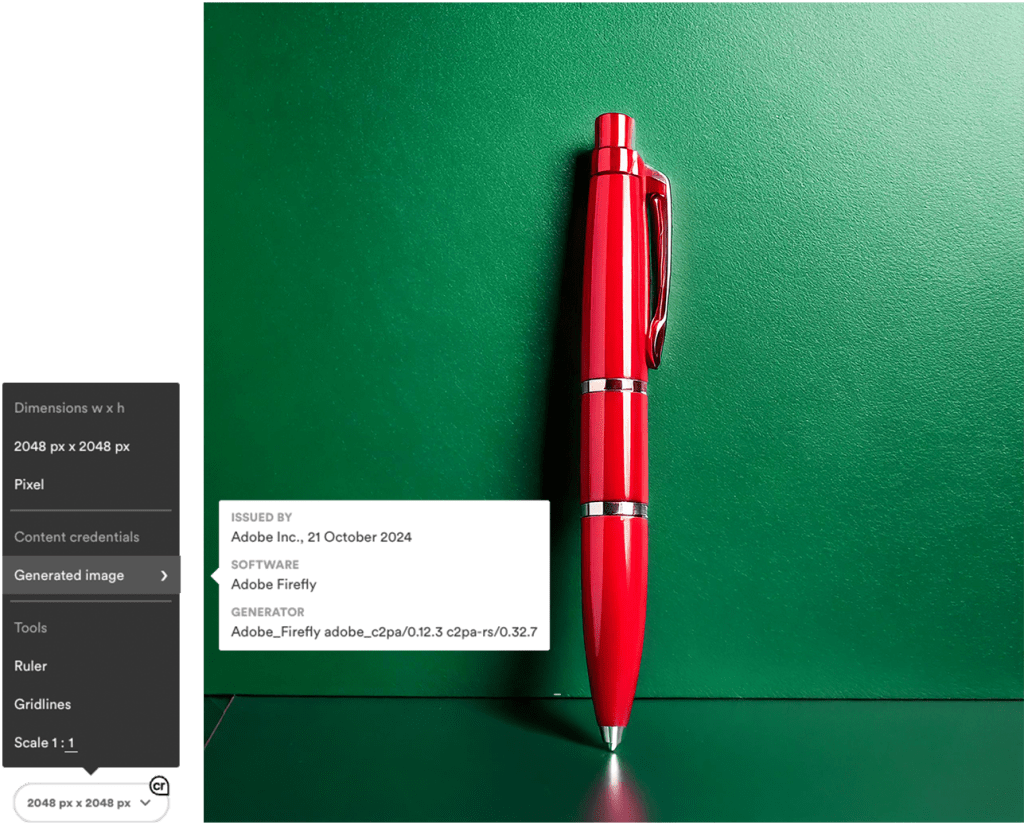
PageProof Smart Check: CR provides content credentials checks on an Adobe Firefly-generated image.
PI Content Credentials check works alongside existing Smart Check features such as fonts, colors, color profile, and linked asset analysis, offering immense value to marketing and creative teams working with digital assets.
For imagery, PDFs, audio files, and video files, PageProof gives reviewers clear insight into the file’s origin, how it was created, and whether any part of it may have been generated or modified by AI.
This added transparency helps teams verify authenticity, understand the production pathway, and make confident, informed decisions – bringing greater clarity and trust to the entire video review process.
Why Content Credentials are worth your attention
As the differences between real and AI-generated content become harder to spot, Content Credentials offer a way to protect authenticity and build trust.
For creators, they provide a chance to get the credit you deserve, while for consumers, they offer transparency and peace of mind.
As digital content continues to evolve, modern tools can help ensure that the media we create and consume is trustworthy.
Whether you’re a digital artist, photographer, or just someone who interacts with content online, understanding and using Content Credentials can make a big difference in navigating modern content authenticity issues.